 Industries
The AI Market in Japan: Spearheading Industry Innovation
By Paola Marisela González
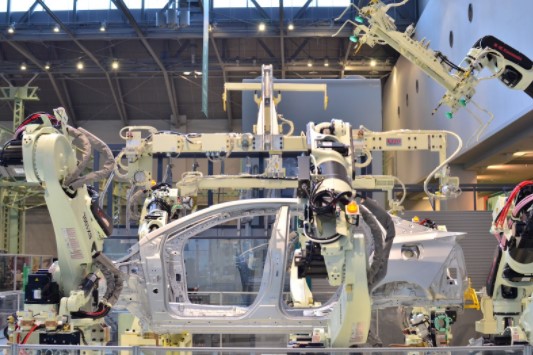
The global AI market is experiencing exponential growth, permeating diverse sectors such as security, manufacturing, marketing, healthcare, education, agriculture, and infrastructure. In Japan, while the AI sector has traditionally focused on robotics, particularly in medical and industrial applications, there is a burgeoning interest in expanding AI technologies beyond hardware into software development.

What does Japan’s AI sector look like?
Manufacturers in Japan’s AI sector are grappling with the task of customising robots to better serve diverse user demands. Currently, there is a shift in AI trends towards the development of self-driving cars, drones, smart cities, and factories, alongside continued innovation in AI for service industries like healthcare and long-term care services.
Key to Japan’s technological progress in AI are research institutions such as the National Institute of Advanced Industrial Science and Technology (AIST) and RIKEN, the nation’s largest comprehensive research institution. These centres drive innovation through their diverse projects focused on advancing AI technologies.
As Japan embraces the potential of AI to revolutionise various aspects of society and industry, there is a growing emphasis on collaboration, innovation, and adapting to evolving market demands.
Innovative AI companies in Japan
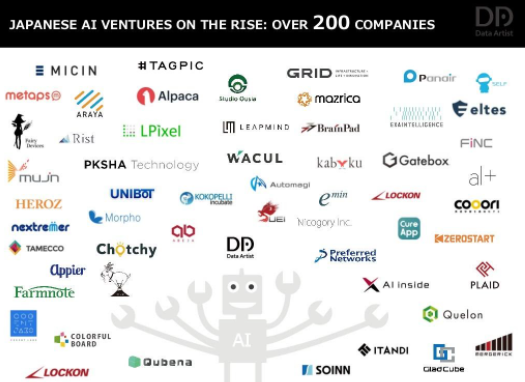
Over 700 companies in Japan specialise in AI technology, ranging from large competitive enterprises to small and mid-sized companies, along with start-ups. Among this, the notable players are:
NEC
Based in Tokyo, NEC is a leader in the integration of IT and network technologies that has been active in AI research since the 1980s. They provide sensors, computing, networking and analysis that brings technological solutions to benefit society. Their active data solutions are able to predict, monitor, and solve challenges, responding intelligently to adverse events. They offer smart solutions in diverse areas such as aerospace, aviation, broadcasting, healthcare, retail, and telecommunications, among other sectors.
Abeja
Another company working with Artificial Intelligence in Japan is a start-up called Abeja. Founded in Tokyo in 2012, they have supported AI implementation for over 150 companies, across such diverse industries as; manufacturing, infrastructure, logistics, and retail. Besides this, they have raised more than $45.4 million USD from investors like Google and Nvidia. Abeja is a platform that integrates AI technologies with accumulated data. They are focused on the areas of machine learning / deep learning, as well as retail store analysis.
Mujin
Mujin is a robotics company based in Tokyo, Japan, renowned for its groundbreaking advancements in industrial automation and robotics technology. Founded in 2011 by Rosen Diankov and Issei Takino, Mujin has rapidly emerged as a leader in the field, specialising in creating intelligent robotic systems for industrial applications.
Softbank Robotics
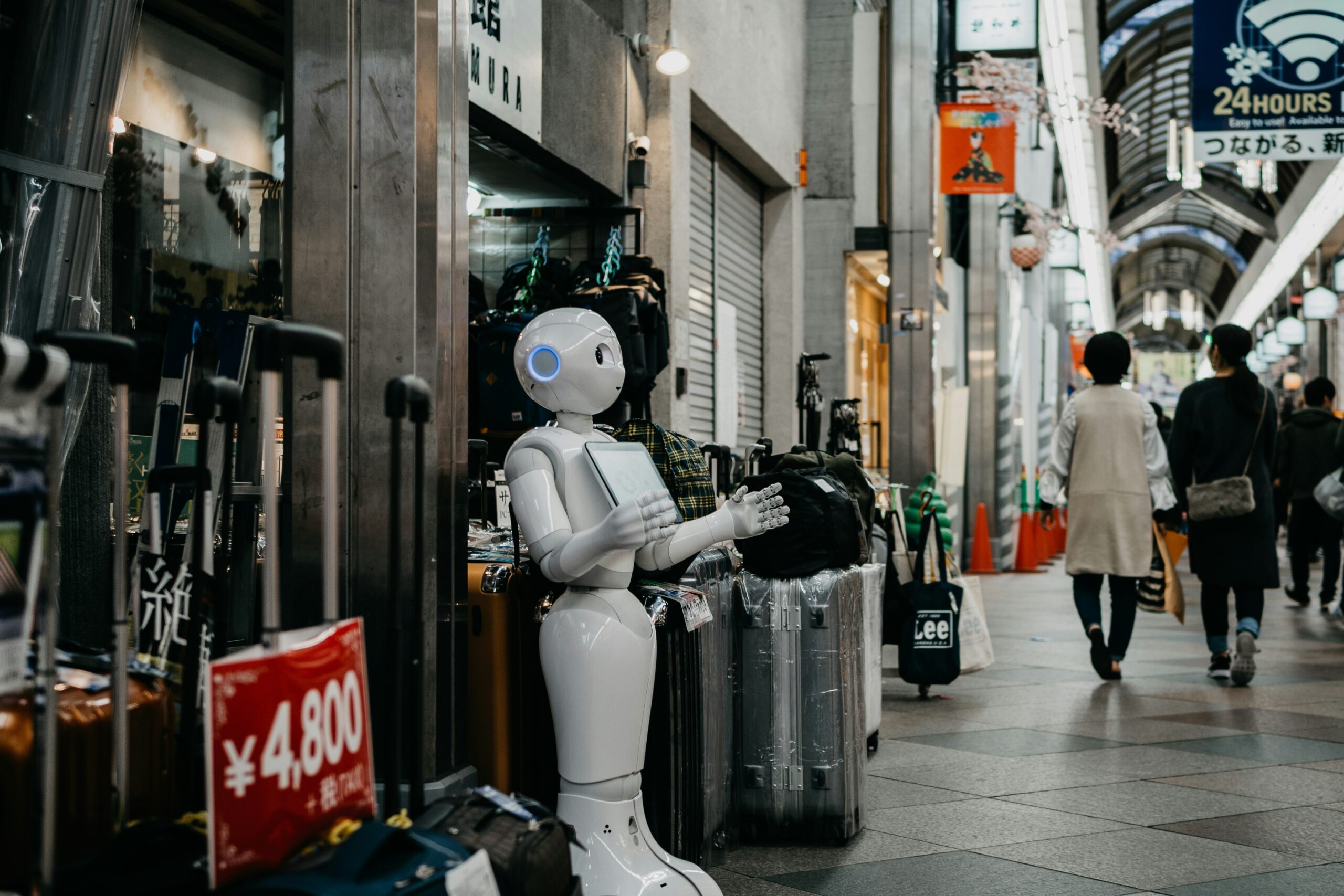
Softbank Robotics is the robotics division of Softbank that develops humanoid robots for consumer and enterprise applications relevant to the fields of education, business and personal use. Nowadays, they have offices in Tokyo, Paris, London, San Francisco, Boston, Shanghai, Beijing, Shenzhen, Hongkong, Singapore, Seoul, and Sydney.
There are currently over 35,000 SoftBank Robotics robots used in more than 70 countries offering innovative applications for retail, tourism, healthcare, finance, education, facilities management and cleaning. Their main products are Nao, Pepper, and Romeo. These robots incorporate sensors, microphones, speakers, cameras, and speech recognition technology to provide assistant according to the customer’s needs.
Smart cities and the AI market in Japan

Smart Cities have appeared as one of the most ambitious projects in the AI market in Japan. The development of Smart Cities responds to a growing concern about environmental issues and the creation of local solutions for energy management. The Japanese Ministry of Economy, Trade and Industry (METI) has been investing in the increasing numbers of Smart City projects since 2010, and independently subsidised projects have emerged too, increasing the research in the field of renewable energies and sustainable lifestyle solutions.
The construction of Smart Cities also represents a business opportunity for European companies that are expert in power transmission technology and data management, which are areas that have not been exploited in Japan’s AI Sector.
One example of an upcoming Smart City project by Toyota is the Woven City, due to be constructed at the base of Mt. Fuji in Japan. The 175-acre city will act as a “living laboratory”, hosting full-time residents and researchers who will test and develop technologies in the areas of autonomy, robotics, personal mobility and smart homes in a real-world environment.
The residents of the city will include 2,000 Toyota employees and their families, retired couples, retailers, and scientists. They will live in smart homes with in-home robotics systems to assist with daily living, and with sensor-based artificial intelligence to monitor their health and take care of other basic needs. The city will be completely sustainable, with energy powered by hydrogen fuel cells and roads for self-driving vehicles.
Woven City is expected to be ready to receive occupants within five years and will provide an opportunity to realise the potential of Artificial Intelligence in Japan. Nevertheless, one of the aims of the city is to encourage human connection, and for that reason, it will include multiple parks and a large central plaza for social gatherings.
Opportunities in Japan’s AI sector
The Japanese AI market continues to experience significant momentum in late 2025/ early 2026, driven by substantial government commitments and strategic initiatives. The government has approved its first basic AI plan in December 2025, aiming to position Japan as a global leader in AI development and utilisation while addressing risks. This includes a major push for domestic AI capabilities, with public funding support reaching approximately ¥1 trillion (around $6.34 billion) over five years starting in fiscal 2026 for home-grown foundational AI models, in collaboration with private partners like SoftBank and Preferred Networks.
Additionally, the Ministry of Economy, Trade and Industry (METI) has nearly quadrupled budgeted support for cutting-edge semiconductors and AI to about ¥1.23 trillion ($7.9 billion) for the fiscal year beginning April 2026—part of broader commitments up to ¥10 trillion ($65 billion) through 2030 for AI and semiconductors. These investments target domestic foundation models, data infrastructure, physical AI (e.g., AI controlling robots and machinery), and supply chain resilience, complementing earlier efforts like the 2025 AI Promotion Act, which promotes an “innovation-first” environment with minimal penalties to attract investment and experimentation.
While OpenAI opened its first Asia office in Tokyo in April 2024 (its initial regional foothold, with a Japanese-optimised GPT-4 model), the broader landscape has evolved with increased foreign interest and domestic focus. This governmental drive, combined with private sector contributions from companies like NTT and others investing tens of billions in AI infrastructure, signals robust growth potential.
Strategic partnerships with Japanese firms continue to offer foreign companies valuable access to local insights, resources, and co-creation opportunities for AI solutions tailored to Japan’s unique industry needs—particularly in manufacturing, healthcare, finance, robotics, and semiconductors.
Market expansion remains highly attractive, as Japan’s diverse and advanced ecosystem provides multiple entry points across sectors. By establishing distribution agreements, alliances, or joint ventures with local partners, foreign firms can effectively reach new customer bases and capitalise on Japan’s substantial market potential amid AI-driven economic contributions projected to reach trillions of yen by 2030.
These collaborative approaches enable foreign companies to build a solid presence in Japan’s AI, fostering a mutual growth, technology transfer, and innovation. Overall, Japan’s AI market presents foreign developers with a prime opportunity to influence the trajectory of AI adoption and development in the region, leveraging its supportive regulatory framework, heavy infrastructure investments, and emphasis on human-centred, reliable AI to drive long-term success.
See also:
Smart Cities in Japan: Practical Innovations for Conscious Future Living
IoT in Japan: Essential Yet Lacking?
Keep checking back or follow us on LinkedIn, Facebook or Twitter to get notified about our latest posts. We’ll be adding more articles relating to technological innovations in Japan, so watch this space!
Alternatively, feel free to get in touch and see how we can help you expand into the Japanese market effectively.